Hungarian Consul Visits the Kurdistan Democratic Party’s Foreign Relations Office
The Hungarian Consul visited the Kurdistan Democratic Party’s Foreign Relations Office, where discussions focused on political relations and regional and international tensions.
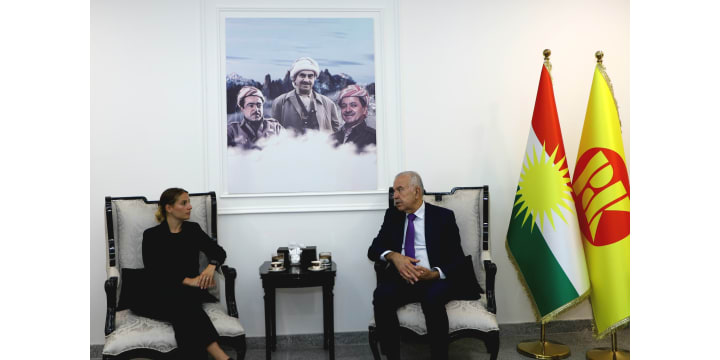
Mr. Hoshyar Siwaily, Head of the Kurdistan Democratic Party’s Foreign Relations Office, received Ms. Dominika Kovács, Acting Consul General of Hungary in the Kurdistan Region. During the meeting, they held extensive discussions on political developments, regional security, economic cooperation, the future of relations between Kurdistan and Hungary, and the tensions affecting the region.
Hoshyar Siwaily welcomed the return of Hungary’s diplomatic representation following a period of absence caused by regional tensions. Both sides emphasised the importance of the historic and long-standing relations between Hungary and the Kurdistan Region. They also stressed the need to maintain political and diplomatic communication and coordination and to expand cooperation into all other fields.
A significant part of the discussions was devoted to the ongoing political crises and the current situation in the Middle East and Europe resulting from the wars between the United States and Iran, and between Russia and Ukraine.
Regarding the Kurdistan Region, following the parliamentary elections of 20 October 2024, Mr. Siwaily expressed concern over the failure to form a new cabinet of the Kurdistan Regional Government. He stressed that reactivating Parliament and forming a unified government represented the best way out of the present situation.
He stated that the Kurdistan Democratic Party was ready to facilitate this process and that all political parties should respect the election results and act in accordance with the trust placed in them by the people of Kurdistan.
Regarding the formation of the new Kurdistan Regional Government cabinet, Hoshyar Siwaily stated that there was no legitimate justification for obstructing its formation, except for partisan and personal interests that did not serve the higher interests of the Kurdistan Region.
He said that three options currently existed: forming a new government, holding another election, or allowing the current situation to continue. Forming a government was identified as the best solution, while the continuation of the present situation was considered the worst option.
The meeting underlined that dialogue and compromise between the Kurdistan Democratic Party and the Patriotic Union of Kurdistan were fundamental necessities. It was also clarified that compromise should not be interpreted as retreat or surrender. Rather, it should be viewed as a democratic mechanism for reaching a political settlement acceptable to all parties.
Despite the current difficulties, the Head of the KDP Foreign Relations Office expressed optimism based on the successful past experience of the KDP and PUK in overcoming disputes and unifying the two administrations.
According to him, that experience demonstrated that both parties possessed the ability to overcome major disagreements and cooperate effectively within the framework of a unified cabinet.
The impact of internal political divisions on the Kurdistan Region’s position in Baghdad was also discussed. Both sides agreed that political unity would strengthen Kurdish representation within federal institutions and enhance the Kurdistan Region’s ability to protect its constitutional and economic rights.
Regional security featured prominently in the discussions, particularly tensions involving Iran, the United States and Israel. The participants discussed missile and drone attacks against Iraq and the Kurdistan Region, the presence of Iranian Kurdish opposition groups, and the need for close coordination with the Federal Government of Iraq.
The Kurdistan Region’s commitment to neutrality, balanced relations with neighbouring countries, and the continuation of its partnership with the United States and European countries was reaffirmed.
The forced handover of members of the Iranian Kurdish opposition was rejected, while the importance of preventing any armed activity from the territory of the Kurdistan Region against neighbouring countries was also acknowledged.
The meeting also addressed the future of Hungarian military cooperation and broader international assistance in light of changes relating to the mission of the international coalition.
Hungary was encouraged to explore possible ways of continuing or restoring its security participation, either through bilateral arrangements or multilateral frameworks.
Economic cooperation was another major topic. Both sides considered Hungary’s continued participation in the Kurdistan Region’s energy sector to be important. They also discussed opportunities to expand trade and investment and to increase the participation of Hungarian companies in international exhibitions and commercial events.
In conclusion, the participants agreed on the importance of strengthening relations between the Kurdistan Democratic Party and Hungarian political parties. This included cooperation through European and international networks, such as the European People’s Party EPP and the International Democracy Union IDU.
KDP Delegation Visits the Consulate General of the Republic of Korea