Prime Minister Masrour Barzani Outlines KRG Priorities on Regional Stability, Baghdad Relations, and Public Services
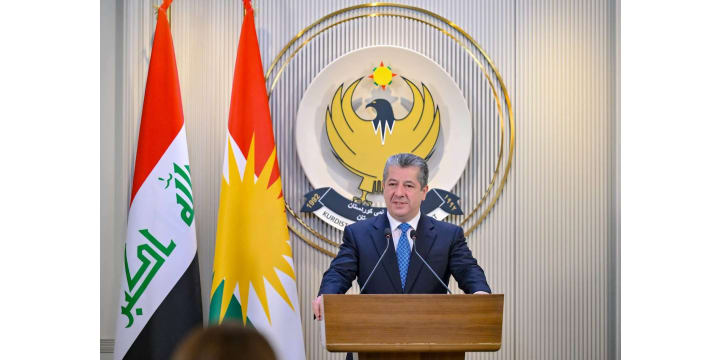
Prime Minister Masrour Barzani addressed journalists on several key issues affecting the Kurdistan Region, Iraq, and the wider Middle East, emphasizing the KRG’s commitment to peace, stability, public welfare, and cooperation with Baghdad.
Regional Situation and KRG Position
The Prime Minister said the wider region continues to face tension, war, and instability, which have affected daily life and economic conditions across the Middle East, including the Kurdistan Region. He stressed that the Kurdistan Region is not part of any conflict and supports peaceful solutions to all regional disputes.
He thanked the people of Kurdistan for their patience, resilience, and support during difficult times, acknowledging that rising prices and regional crises have made life harder. However, he expressed confidence that the Kurdistan Region will overcome the current challenges, as it has overcome previous crises.
Relations with Baghdad
Barzani reaffirmed the KRG’s support for the federal government in Baghdad, led by Prime Minister Ali Zaidi, and said the Kurdistan Region remains committed to cooperation on reform, anti-corruption efforts, and economic recovery.
He noted that Iraq is facing a serious economic crisis, partly due to disruption in oil exports through the Strait of Hormuz, and said the KRG is ready to help Baghdad find solutions.
The Prime Minister also said progress is being made on resolving trade-related issues, including the ASYCUDA customs system. He said a solution is close and would help improve trade and increase revenues for both the Kurdistan Region and Iraq.
Salaries and Revenue Issues
Regarding public-sector salaries, Barzani said the KRG remains in continuous contact with Baghdad to ensure salaries are paid on time. He referred to a previous decision requiring the Kurdistan Region to provide 120 billion Iraqi dinars, saying the KRG has met its obligations when internal revenues were sufficient.
However, he explained that reduced trade and lower revenues have affected the KRG’s ability to meet this obligation. He called on the federal government to review the decision and said the best solution is to increase revenues through expanded trade routes and stronger domestic income.
Formation of the Kurdistan Regional Government
On domestic politics, the Prime Minister said nearly 20 months have passed since elections were held, but a new KRG cabinet has still not been formed. He called for parliament to be reactivated and for a government to be formed that reflects the will and aspirations of the people.
He urged political parties to act responsibly, saying the people expect a government that delivers services across all parts of Kurdistan without discrimination.
Electricity and Gas Supply
Barzani addressed the electricity issue, reaffirming the KRG’s commitment to providing 24-hour electricity to citizens. He said the project itself is progressing, but electricity generation has been affected by reduced gas supply.
He explained that most of the Kurdistan Region’s gas comes from Dana Gas at the Khor Mor field, but the company recently reduced production due to security concerns. This has caused a major drop in gas availability and directly affected electricity generation.
The Prime Minister said the KRG is in talks with Dana Gas and other suppliers and expects the issue to move toward a solution soon. He added that increased gas production would also improve condensate output, helping gasoline and fuel production.
Fuel Prices and Oil Share
Barzani said recent increases in gasoline and fuel prices are partly due to regional war and rising global oil prices. He emphasized that the KRG is working to set fair and realistic fuel prices for citizens.
He explained that, unlike the federal government, the KRG does not receive federal sovereign funding to cover oil extraction costs. As a result, these costs fall on the Kurdistan Region under its contracts with oil companies.
The Prime Minister said the Kurdistan Region is entitled to a fair share of oil for domestic consumption. Based on the 12.6% share used by Baghdad in dealings with the KRG, the Kurdistan Region should receive around 126,700 barrels per day for local use. However, a previous federal decision limited the Region to only 50,000 barrels per day, which he described as unfair.
He said the KRG is asking Baghdad either to allow increased local production for domestic use or to provide the remaining quantity needed, around 70,000 barrels per day. This, he said, would help reduce fuel prices and meet public demand.
The Prime Minister also noted that the government has reviewed gasoline pricing, with normal gasoline set at 750 IQD and commercial gasoline not exceeding 850 IQD. He said further review is underway for improved and super gasoline, which remain scarce in the market.
Final Message
Barzani concluded by stressing that the KRG stands with the people of Kurdistan and will continue defending their rights. He called for unity, solidarity, and cooperation among political parties to confront current crises and fulfill promises made to the public.
He said the Kurdistan Region needs collective action more than ever to overcome challenges and protect the interests of its citizens.
Prime Minister Masrour Barzani Outlines KRG Priorities on Regional Stability, Baghdad Relations, and Public Services